Gender & Pop Culture: A Conversation
Written, Created, and Designed by: Ella Herman for ENG1102 at Seminole State College
Popular culture is something that surrounds us every day. Pop culture are the trends we give into, the music we listen too, social media platforms, television and film, the clothes we wear and the stores we buy them from. It is no secret that pop culture influences the world every day, but to what end? Does popular culture influence every part of the world? America is known for being heavily influenced by many different cultures, leading Americans to adopt certain aspects of these cultures to their fashion choices, lifestyles, etc. In recent years, the discussion of gender expression and equality has taken center stage in popular culture trends.
The Man in the Dress
Harry Styles, one of this generations most beloved popstars and fashion icons, appeared on Vogue Magazine’s 2020 cover story wearing a dress (Bowles). There were mixed responses to the story, including conservative Candace Owens tweeting “Bring back manly men” (@RealCandaceO). Fans of Styles were excited for him and found it inspiring that he, a cis man, wore a dress, traditionally worn by women, on such a large platform. This is just one of the many instances that caused people to question about gender roles and expressions’ place in pop culture and how pop culture itself influences people’s views on gender.
“
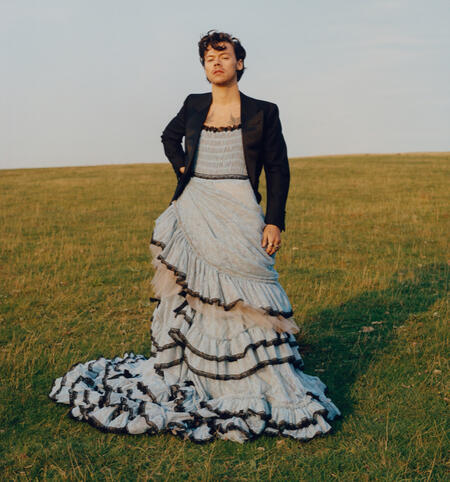
“Playtime With Harry Styles.” Vogue, 13 Nov. 2020.
Gender Identity in TV
Like everything, people have different opinions on pop culture, but in some ways, it binds the social world together. People stay connected through discussions of popular things. The discussion of gender identity has started to become mainstream in recent years. This is not because it is new, far from it, but because people are finally starting to take part in a larger, more important conversation. Gender equality and gender roles are nothing new to people, but the topic of the gender binary in which defines male and female roles has started to infiltrate popular culture. Popular culture are the mainstream ideas that the general public knows and talks about. While gender roles are widely discussed by everyone, gender identity is not. The article “Social Equity and Popular Culture: Gender and Gender Identity on TV” defines gender identity as “[reflections] [of] one's self-identification of gender, separate from one's biological sex assigned at birth” (Borry). The article also takes a deep dive into television shows like Modern Family and Grey’s Anatomy[s] inclusion of the gender identity conversation, which goes to show, how the discussion of gender is influencing and infiltrating popular culture.

Grey's Anatomy. "Add It Up." Season 15, Episode 18.
Text
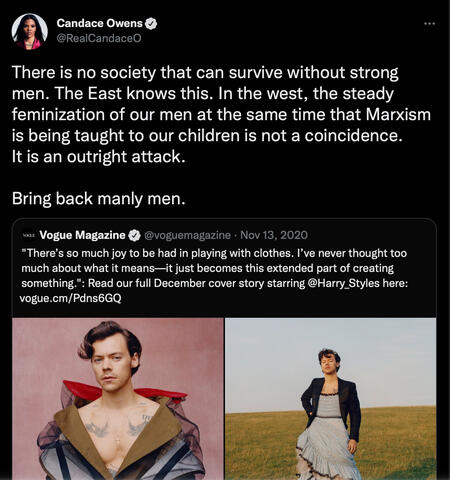
@RealCandaceO (Candace Owens) via Twitter.
Some people such as, Candace Owens did not appreciate seeing a man, Harry Styles, in a dress. Erin Borry calls this “nervous conversations” and states, “When discussions of social equity arise, the nervousness may invoke fear among individuals to engage the topic” (“Social Equity”). People who do not experience gender dysphoria, or question their self-identity, may not entirely understand what it means to explore gender expression and identity. It is fear of the unknowing that prompts people to react in harsh ways. Education and discussion of these topics are important in order for them to understand. It is crucial that television shows like Modern Family and Grey’s Anatomy show representation and discussions about gender identity and pronouns.
How Gender Effects Success
The music industry is one of the biggest examples of the way gender plays into success. The mass media is known for using women and promoting them as sexy and desirable (the way men see them) as a way to gain popularity. This isn’t the case for men, and many young women who look up to these female pop stars are being influenced in the wrong way. At a Ted Talk in 2015, Kristin Lieb discusses how pop culture’s influence on young adults, especially young women, is teaching the wrong “lessons” and ideas about gender. Lieb tells a story about one of her students and the way she reflected on herself after being shown Jean Kilbourne’s Killing Us Softly which shows women in ads over four decades. Spoiler alert: these ads are provocative and essentially have women selling themselves; “Sex Sells.” Lieb says this student would go out with her friends and while getting ready would “rip [them]selves apart…and then try to rebuild each other…so we can go out with confidence” (3:13-3:25). Young women are influenced by what they see in the media and what they think others want. They’re being taught that to be desirable, they must appeal to men by changing their appearance to a more luxurious and sexier look. Lieb then dives into an idea she created called “The Life Cycle of Popular Music Stars” (5:59). This idea describes twelve different types of women in the music industry, stating “There are about twelve ways of being if you’re female at the top of the music industry and if you can’t fit into one of these twelve different types, you’re not going to get there or you’re not going to remain there” (Lieb 6:03-6:12). All of these “types of women” essentially play into stereotypical roles of a female, for example, the girl next door or the “temptress,” all of which draw men in, to want them.
Life Cycle of Popular Music Stars
The Good Girl
Temptress
Diva
Hot Mess
Provocateur
Staying on the Charts, at What Cost?
The music industry is a large, elusive area in which gender roles and personas play a large part in making a profit. Music producers only want what they can sell and that is entirely dependent on current trends and what the general public wants. As stated in the Ted Talk, “pop stars are created and popularized, through the lens of the people who create and popularized them” (Lieb 5:11-5:17) and majority of who “create” these stars are men. Not to mention the people who “popularize” them is the general public, who is influenced by current trends. Lieb suggests how a pop star is shown to the world, is how they stay on the charts. The article “Gender and Popular Culture: A Comparison of Promoter and Listener Preferences for Popular Music Artists” brings a new perspective to the music industry expressing “producers and consumers are trapped within this system of production, as ‘the industry submits to the vote which it has itself inspired’ (qtd. in Donze). This can be applied to how women are treated in the music industry. Producers, whether that be an agent or PR manager, create a persona for these stars in order to sell records. The article elaborates by stating “Contemporary production of culture approaches frame production processes as a dialogue with consumers, but one where the quality of musical content takes a back seat to the pursuit of profit and competition for market share, which is particularly important for generating platinum sales” (Donze). This basically means mass media does not care about the quality of a song, just the star, the persona the singer is creating; this generates sales.
How Does a Persona Generate Music Streams & Sales?
Sometimes it is the opposite for men and women. Women who appear desirable and sing about sex, generate profit. Men like David Bowie and Harry Styles, who tap into their femininity, stay on the charts.
Gender Influences Pop Culture
Gender and pop culture are intertwined. There are many ways gender can have an influence in popular culture. Just from the examples of gender conversations shown in TV, gender stereotypes and roles placed on women in the music industry, and even men wearing dresses, it is no secret gender expression influences pop culture every day. Solely from the inclusion of gender identity conversations on television, and male pop stars breaking gender norms, it is clear the influence the topic of gender has made gender identity and expression a mainstream conversation. It is important to talk about gender in the media, especially when uprising female stars are out on a pedestal expected to perform for others, simply because that’s what the mass public wants. Talking about gender and the role popular culture plays into the negative and positive stereotypes places on them is important. There can be a shift in how people include gender in conversations and music moguls treat women. Pop culture are the ideas humans love to talk about. Bringing gender discussions into society makes a difference and influences pop culture for the better so that a new generation can grow up in a scene that welcomes anyone with no expectations.